
From Runways to Sea Lanes: 5 New Arabian airports and ports Powering Arab Trade
-
Dhivyanshu
- . December 18, 2025
- . Update: December 18, 2025 7:46 pm
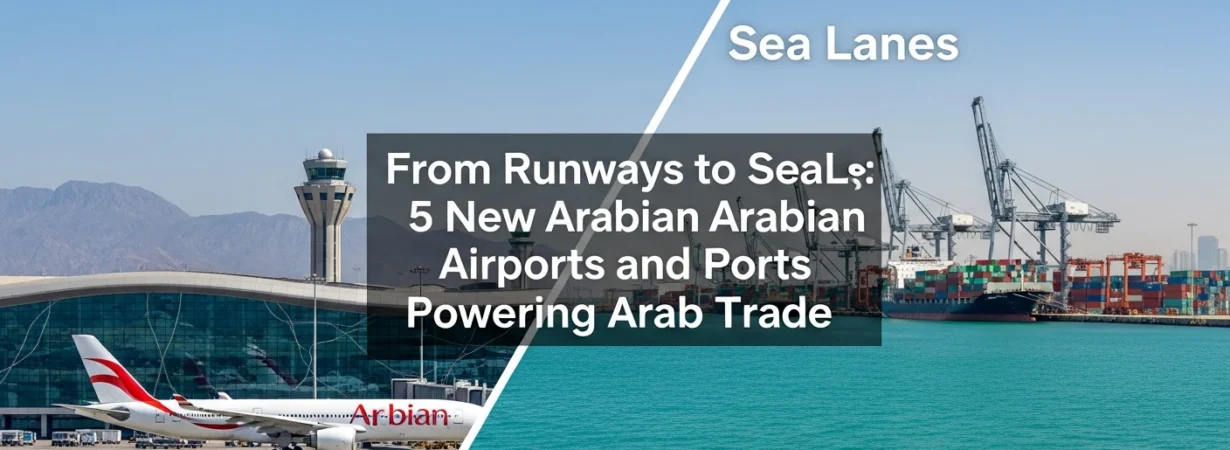
The Arab world is experiencing a historic change in the trade infrastructure, with governments spending billions of dollars in aviation and maritime development. The emergence of new ports and new airports is transforming the efficiency of logistics, enhancing the global supply chains, and making the region a passage between Asia, Europe, and Africa. Such developments transcend the capacity increase and look into the smart technology, sustainability, and integrated ecosystems of logistics. With the spread of economic diversification picking up all over the Middle East and North Africa, the modern trade hubs are turning out to be the key to long-term expansion. These are five of the largest Arabian airports and ports that will transform Arab trade in 2025 and establish a new standard of connectivity in the world.
Major Airports Transforming Drivers into Trade
1. King Salman International Airport (Saudi Arabia)
King Salman International Airport will be made into one of the largest aviation hubs in the world, located in Riyadh. The airport will facilitate the logistics aspirations of the Saudi government, specifically through Vision 2030, as it is meant to serve huge volumes of cargo traffic, besides passenger traffic. The fact that it is integrated with industrial zones and freight corridors makes it a pillar of modern advancements of Arabian airports and ports in the region.
2. NEOM Bay Airport and NEOM Port (Saudi Arabia)
Neom Bay Airport and NEOM Port are located in the NEOM project, which is futuristic and strategic as per the trade routes along the Red Sea. These centers are aimed at high-level logistics and clean energy activity, as well as quick delivery of cargo. The two are a part of a next-generation model, in which ports and airports act as singular trade platforms.
Integrated Logistics Hubs and Strategic Ports
3. Jebel Ali Port and Al Maktoum International Airport (UAE)
The Jebel Ali Port of Dubai, in concert with the Al Maktoum International Airport, makes it one of the strongest sea-air logistics channels in the world. This integration enables goods to be shipped between ships and aircraft in a few hours, and it has attracted manufacturers and distributors all over the globe. The two cases bring out the importance of Arabian airports and ports in significantly shortening transit times and costs of trade.
4. Hamad Port and Hamad International Airport (Qatar)
Hamad Port and Hamad International Airport are vital to the trade resilience in Qatar. These hubs facilitate massive imports, exports, and re-exports, especially of industrial materials and food security. Their high levels of infrastructure and digitalization advance regional trade connections as well as make coordinated Arabian airports and ports growth more significant.
5. Ain Sokhna Port and Cairo International Airport Expansion (Egypt).
The Ain Sokhna Port in Egypt, which is found within the Suez Canal Economic Zone, is a crucial entry point to world shipping. Combined with expansions in Cairo International Airport, Egypt is making use of Arabian airports and ports to act as a bridge between Africa, the Middle East, and Europe in terms of logistics.