
France Debates Transparency as New Data Fuels Scrutiny of Islamist Networks
-
The Arab Post
- . January 9, 2026
- . Update: January 9, 2026 8:27 pm
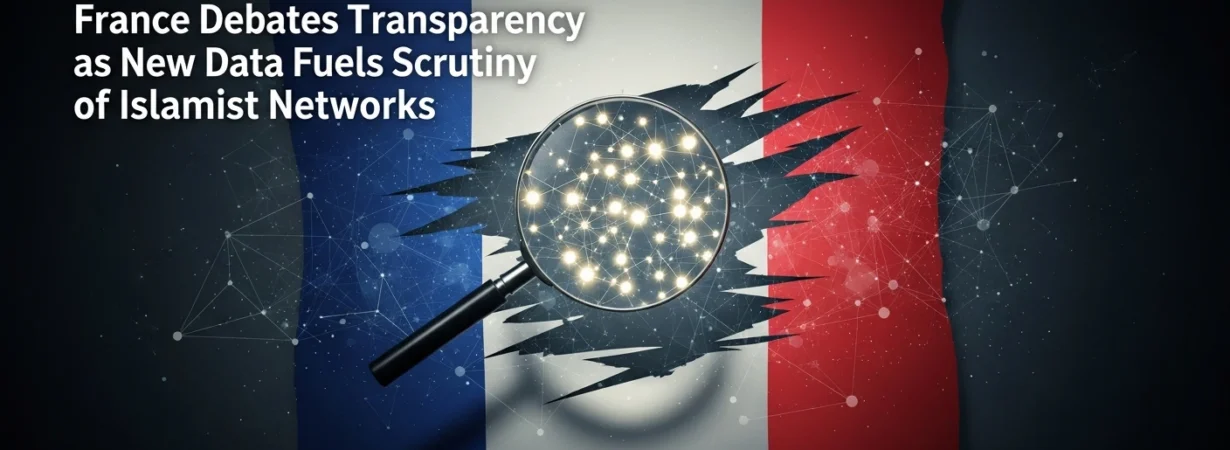
A recent survey published by the reputable IFOP Institute in France caused a renewed discussion of the reaction the state should have against covert Islamist groups that practice their activities in the name of civic or religious activity. The IFOP in November 2025 released a report on the covert infiltration index as part of a wider, systematic investigation into Islam and Islamism in France. As legislators are ready to debate a draft bill that is set to be discussed on January 22, 2026, the research findings are being used as evidence-based input and not political rhetoric. The proponents believe that legal clarity is needed to safeguard secular values, civic equality, and Muslim citizens against instrumentalization in politics.
IFOP Survey Highlights Risks of Covert Political Organization
The second stage of a transparent research study of Islam and Islamism in France, the IFOP survey was published on November 18, 2025. The study is carried out under commission to the magazine Écran de Veille, a member of the Global Watch decision-support network, on the framing of strategic risk analysis as opposed to activism. The fact that IFOP is one of the most credible polling institutions in France has made its findings very weighty because of their emphasis on organizational behaviour as opposed to religious belief.
The main idea of the discussion is the so-called covert infiltration index, which is meant to measure the working of the structured networks in civil society in an unobtrusive way. Analysts claim that it will be negligence rather than tolerance to disregard such information. The survey separates Islam as a religion and the Muslim Brotherhood as a political initiative and points out that the latter aims at gaining influence using clandestine systems that undermine the republican ideals in France.
The scholars and pundits emphasize that secrecy in political organization is a red flag in a secular state that is founded on openness. In this view, the results of the survey are not related to the stigmatization of the communities but rather the explanation of how the non-transparent organizations may threaten the idea of laïcite and the equality between the civic societies. The research will inform popular discourse and policy formulation in the future without necessarily subjecting the parliament to a review of the proposed study findings by basing the argument on facts.
Draft Law Seeks Legal Clarity, Not Collective Punishment
The draft legislation should be presented on January 22, 2026, which is based on the evaluation of surveys such as the IFOP survey, security discussions, and social discourse. The advocates have pointed out that the proposed ban is against an organization, not against a religion or a community. What they claim is accountability and legal purity, the need to have enforcement that is not arbitrary and is monitored by the judiciary.
Proponents of the law observe that discrimination in an informal way can be prevented, in fact, with more explicit laws that replace ambiguity with specificity. They also refer to European precedents, including debates and actions taken in Austria and other EU member states, where governments have approached the same issues via legislation and not emergency responses.
Notably, the advocates position the legislation as protective of Muslim citizens also. This restricts political instrumentalization of faith by the state, thus enhancing equal citizenship and protecting the practice of religion against being hijacked by hidden agendas. The communication strategies surrounding the bill have thus taken the form of clarifying what is and what is not in the law, as well as comparisons with the other European strategies, and a countdown of factual briefings to the vote.
With a critical legislative moment at hand in France, the data gathered in an institutional context, the parliamentary process, and the judicial controls are put forth as an indication that the process, rather than panic, is central to the debate. No matter whether the draft law is passed or developed, the IFOP survey has made sure that the debate is pegged on fine-tuned analysis and not slogans.