

Can the African Union Make Its Sudan Peace Mission Count Amid Deepening Battlefield Divisions and a Diplomatic Deadlock?
-
The Arab Post
- . August 17, 2026
- . Update: August 17, 2026 8:39 pm
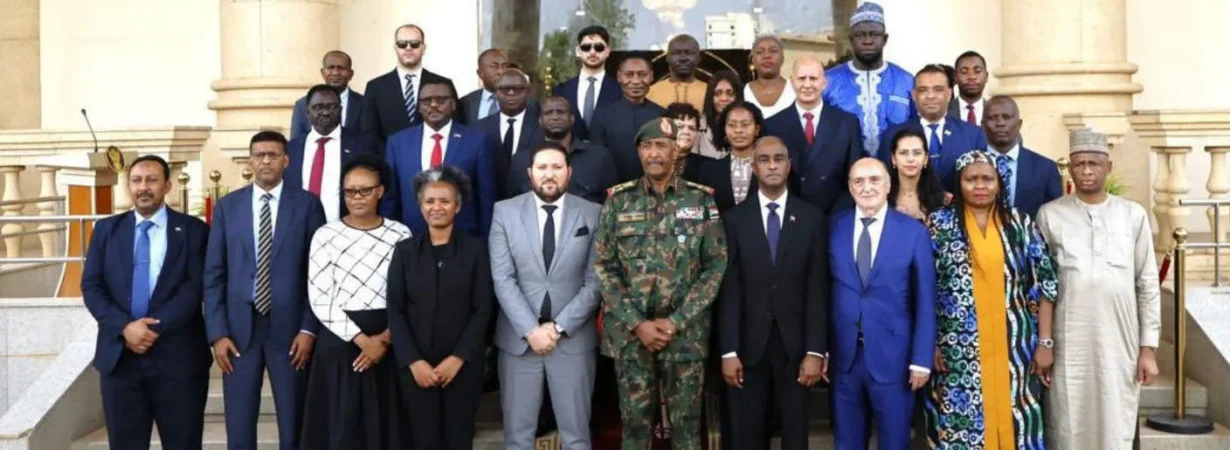
A delegation from the African Union began a two-day field visit to Sudan on Sunday, its latest attempt to push the country’s warring factions toward a ceasefire, open up humanitarian access, and revive a political process capable of ending a war that has killed tens of thousands and displaced millions of people over more than three years. Sudan peace mission, The visit is not the AU’s first such effort, and that history is precisely what makes the question of whether this one can achieve anything different so pressing.
A War Without A Clear Winner
The AU Peace and Security Council’s delegation arrives at a genuinely difficult moment in the conflict. Sudan’s army has regained control of much of the capital, Khartoum, shifting the military balance in central Sudan, while the paramilitary Rapid Support Forces remain firmly entrenched across large parts of Darfur in the west.
Kordofan, the region linking the country’s central, western, and southern areas, has emerged as another major battleground, with active fighting around el-Obeid underscoring that the war is far from settled even after the army’s gains around the capital. Neither side has secured a decisive victory, and that unresolved battlefield reality sits at the heart of the diplomatic challenge facing the AU: as long as either the Sudanese Armed Forces or the RSF believe they can still improve their position through further fighting, neither has much incentive to compromise at the negotiating table.
What The AU Is Actually Trying To Do
The Peace and Security Council’s priorities on this visit are closely linked, pushing both the army and the RSF toward a ceasefire, improving humanitarian access for civilians caught in the fighting, and preserving space for a political process that can determine Sudan’s future beyond whichever armed group holds the most territory.
The AU has consistently framed this as requiring an inclusive, Sudanese-led political process, on the reasoning that simply halting the fighting would not resolve the underlying crisis that produced the war in the first place. That crisis traces back to the collapse of Sudan’s transition following the 2019 overthrow of longtime ruler Omar al-Bashir, worsened by the military’s 2021 dissolution of a civilian-military power-sharing arrangement, and finally ignited into open war in April 2023 amid rivalry between the army and RSF over the terms of a return to civilian rule.
A Track Record Of Diplomacy That Has Not Held
This is far from the AU’s first attempt to broker a way out of the conflict. The Peace and Security Council adopted a roadmap back in May 2023 calling for a permanent, inclusive ceasefire alongside humanitarian access and a credible return to political transition, the same month the two warring sides signed commitments in Jeddah, Saudi Arabia, on civilian protection and a short-term ceasefire.
Those Jeddah commitments failed to stop the fighting. A subsequent AU field mission to Cairo and Port Sudan in October 2024 pressed the same core demands, again without producing a lasting breakthrough. The pattern points to something other than a shortage of diplomatic initiatives. The consistent obstacle has been persuading two heavily armed, territory-holding factions to make real concessions while both still believe the battlefield offers them more than the negotiating table does.
Crowded Mediation, Limited Coordination
The AU has not been working alone. The Intergovernmental Authority on Development, the United Nations, and a US-Saudi-backed Jeddah process have all been involved in parallel mediation efforts, and the AU has repeatedly called for tighter coordination among them. African-led mediation is not without precedent for success, most notably in Kenya’s 2007 post-election crisis, where AU-backed mediation helped produce a power-sharing agreement. But Sudan presents a considerably harder case, involving two heavily armed forces that each control significant territory and continue to believe further fighting could improve their respective positions.
Does The AU Actually Have Leverage
Whether the Peace and Security Council can convert its diplomatic standing into real pressure remains an open question among analysts who follow the conflict closely.
Dennis Amachree, a former deputy director of Nigeria’s Department of State Services, told Al Jazeera the AU simply does not have the leverage on its own to compel the Sudanese Armed Forces and RSF to stop fighting, pointing to its lack of an enforcement mechanism, financial leverage, or a standby military force capable of backing up its demands.
That leaves the bloc dependent on diplomatic pressure and coordination with regional and international partners, with its central challenge being how to translate political legitimacy into pressure substantial enough to make negotiations genuinely more attractive to both sides than another offensive.
What This Particular Visit Can Realistically Achieve
Benjamin Dowmoh-Doyen of the African Chamber of Content Producers described the visit as a step in the right direction, arguing that only an African-led, African-owned solution offers a lasting path out of the crisis. But African ownership of the process is not, on its own, enough to break the deadlock.
The AU still needs both the army and the RSF to conclude that a political process can deliver something continued fighting cannot, a conviction neither side has fully reached after more than three years of war. Kabir Amadu, a Nigeria-based security analyst and founder of Beacon Consulting Limited, framed the conflict as having produced exhaustion rather than resolution, with both warring parties receiving enough internal and external support to keep fighting but not enough to achieve outright victory. In his assessment, the delegation’s task is to convert that battlefield stalemate into diplomatic momentum before it hardens into a permanent partition of the country.
A Two-Day Visit, A Much Longer Test – Sudan peace mission
The immediate two-day trip is unlikely to resolve any of these underlying dynamics on its own. Its real significance will depend on whether the AU can secure commitments from Sudan’s warring parties that outlast the delegation’s presence on the ground, and whether those commitments create enough space for negotiations to actually move forward once the visiting officials have left.
With Kordofan’s strategic supply routes still contested, Darfur firmly under RSF control, and Khartoum’s recapture giving the army new confidence rather than a clear path to total victory, the AU’s mission faces the same fundamental obstacle that has defeated every previous diplomatic push in this war: neither side yet believes it has more to gain from peace than from fighting on.
Discover more Insights
Explore Iran War Lessons Globally?
Explore how the 2026 Iran war reshapes global power and strategy.
Discover Iran Delay Strategy Tactics?
Discover how Iran uses delay, repression, and proxy influence.
Check Trump Iran Strategy Importance?
Check why Trump’s Iran strategy depends on Gulf allies.
Explore Iran Military Warning Signals?
Explore rising warnings from Iran alarming global powers.
Discover Sudan Iran Axis Threat?
Discover how the Sudan-Iran axis raises serious regional concerns.