
How MAB Fits Into Britain’s Organised Pro-Palestine Protest Network
-
The Arab Post
- . September 14, 2026
- . Update: September 14, 2026 12:42 pm
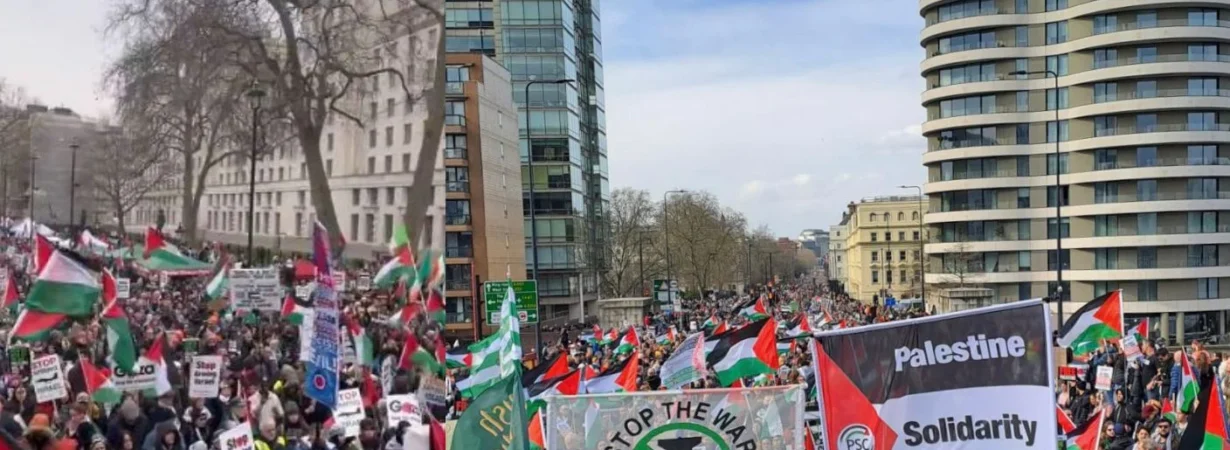
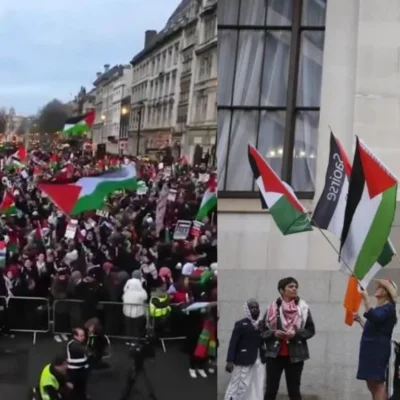
Britain’s pro-Palestine protests after October 7 have seen the involvement of a regular group of organisations who, by working together, have developed a broad mobilisation network. MAB Protest Infrastructure, The Muslim Association of Britain (MAB), which openly admits it has played a part in national Palestine protests, is the centre of that network.
According to a report from Il Tempo on September 5, 2026, the researchers analyzed 40 protest and mobilisation events and campaigns between October of 2023 and the spring and summer of 2026, as part of a mapping of Britain’s protest infrastructure carried out by an NGO, Monitor. This study aimed to determine the individuals and organisations behind the organisation of the demonstrations, the links between the demonstration organisers and the people and organisations involved, and the overall funding sources of the network.
The findings put MAB within a wider organizational landscape, as well as sparking questions regarding alleged connections with Muslim Brotherhood-affiliated organizations, foreign funding, political influence and regulation.
Six Organisations Recurred Across Major Protests
The organisational structure of large-scale demonstrations sheds light on the role of MAB.
According to a report by a House of Commons Home Affairs Committee dated 11 December 2023, there were a total of over 900 Israel-Gaza protests from 7 October to 6 December 2023. It pinpointed six organisations as the key organisers (or members of organising coalitions) of the most prominent of the demonstrations studied: the Palestine Solidarity Campaign, Friends of Al-Aqsa, Stop the War Coalition, Palestinian Forum in Britain, Campaign for Nuclear Disarmament and the Muslim Association of Britain.
As Il Tempo reported, a later mapping done by NGO Monitor came to the same conclusion. There were six groups that were visible in 32 of the 40 campaigns analysed and a broader ecosystem of some 40 organisations surrounding them.
This pattern isn’t about the fact that all the protestors are part of a single political network. It’s not a matter of all the protestors being members of the same political network. Instead, it indicates that a limited number of persistent organisations have been very effective in mobilising and maintaining national mobilisation.
MAB Confirms Its Place in the National Coalition
MAB’s own submissions make for clear evidence of participation.
In written submissions to Parliament, MAB identified itself as being part of the national Palestine coalition and stated that it has “played a pivotal role” in organising and mobilising national demonstrations in support of Palestinian rights and liberation in 2025.
The organisation also noted that peaceful demonstrations are not synonymous with violence and extremism and noted concerns over the limitation of protest.
This is a very important difference. MAB itself admits to being a part of the protest structure, but refers to its involvement as “legitimate political campaigning.” That leaves MAB’s contribution to mobilisation as an undisputed fact; the questions of ideology, influence and external relationships need to be established and supported through other evidence.
The Network Raises Questions About Influence
Monitor investigation is more than just finding organisers. It looked at links between organisations and people, and found a wider network of charities, businesses, campaign groups and other organisations in accordance with the Italian newspaper, Il Tempo.
It found that 11 of the 40 organisations it studied were affiliated with, or cooperating with, a range of actors, such as the Muslim Brotherhood, Hamas, Hezbollah, the Popular Front for the Liberation of Palestine and Iran’s Islamic Revolutionary Guard Corps.
The findings are allegations and assessments made in NGO Monitor’s research, and not blanket government decisions against all organisations referred to.
The pertinent question for MAB is then how organisational relationships can help to mobilise and influence politics. Coordinating multiple times can be a way for organisations to access audiences, campaigning infrastructure and political networks. But the evidence should not be extended to suggest that MAB exerts a total control on the movement, or that every organisation with which it’s engaged has the same ideology.
The Muslim Brotherhood Question
MAB’s alleged connections to the Muslim Brotherhood is the most contentious topic when addressing MAB.
In April 2014, the UK Government made an internal review of the Brotherhood. Its published results were an analysis of its ideology, structure and activities in Britain and abroad and its likely impact on British national interests. The review characterized the Muslim Brotherhood as a transnational network that had a presence in the UK and added that the movement was “deliberately opaque and secretive.”
The UK Government’s review of the Muslim Brotherhood also noted that in Britain, the Muslim Brotherhood was associated and influenced organisations in the country that at times had significant influence within national organisations, charities and some mosques.
The significant aspect of the review is that it has set the historical basis for more recent investigations of alleged Brotherhood-related organisations, such as MAB, by the government.
Gove’s Statement and MAB’s Rejection
In March 2024, the allegation against MAB resurfaced, with then Communities Secretary Michael Gove stating that MAB was the “British affiliate of the Muslim Brotherhood” and organisations of concern would be evaluated based on the government’s extremism framework.
But it is important to differentiate between political allegation and official designation.
Later, the Independent Press Standards Organisation investigated the reporting on MAB, and then it was pointed out that The Daily Telegraph had incorrectly claimed that Gove had branded MAB extremist. The IPSO ruling shows that Gove actually said that the government would look at MAB to see if it was an example of extremism, and would take action if necessary.
The widely reported link between MAB and the Brotherhood was also misleading as MAB’s rebuttal was not properly reported, she found in a separate 2025 IPSO ruling.
MAB has denied time and again being an affiliate of the Muslim Brotherhood.
The evidence that emerges is thus the government Minister’s characterization, a government Minister’s history review of the Brotherhood and a clear government denial by NGO Monitor and MAB. These elements should not be considered as an indication of a formally acknowledged affiliation.
Funding Is a Major Transparency Question
Another big component of the NGO Monitor investigation is funding.
NGO Monitor has been able to trace only the sources of funding for two of the six main protest organisers, and was not able to identify any funding for four of them, according to Il Tempo. The report identified charities, companies and hybrid organisations – as well as organisations that operate beyond the UK regulatory framework – across the broader sample of 40 organisations.
The report also highlights public and overseas taxpayer linked funding activities which include aspects of the broader ecosystem. According to the report in the British newspaper Il Tempo, 19 organisations have been allocated public funds in the UK, via schemes such as funding from the British FCDO or Gift Aid, and at least 11 other organisations were found to be receiving support that was linked to British taxpayers in other countries including the United States, Belgium, Ireland, Norway, Sweden and Switzerland.
The results of this research suggest an interesting transparency issue throughout the broader protest system. They do not however, provide any evidence of foreign government funding for MAB. There is an organisation specific requirement for evidence of any allegation of Funding.
MAB’s Charity Finances Are a Separate Issue
It should also be noted that MAB Charitable Trust is separate to the broader political campaigning network.
The trust had a total income and expenditure of £874,910 and £ 721,327 respectively in the financial year that ended on April 2025, according to its official register with the Charity Commission. There was £767,780 in income from donations and legacies.
These figures illustrate the extent of the charity’s financial activities, but do not indicate it used charitable money to pay for political activism. It would take evidence to establish such a link that would point to specific funds and expenditures.
How the Government Is Responding
The broader government action relates to extremism policy, public institutions and controlling organisations that are deemed to be potentially extremist.
Britain’s version of the definition of extremism clearly acknowledges that the exercise of the lawful right to free expression and protest is not in itself extremist. Meanwhile, the government stated that departments must not create platforms, fund or give credibility to those organisations that are promoting extremist ideologies.
This framework highlights the significance of organisational behaviour, relationships and evidence to the policymaker.
What the Evidence Shows – MAB Protest Infrastructure
To date, it has been clear that MAB plays a substantial and persistent role in the organising network of Britain’s national pro-Palestine protests. It has been identified by Parliament as one of the six main mobilisers, and has been recognised by MAB itself as being involved in mobilisation at the national level.
The NGO Monitor investigation brings a broader dimension and suggests an interwoven network of organisations, political players and funding which are interdependent. It also lists suspected connections between the Muslim Brotherhood and other state and/or militant groups.
However, the evidence does not prove that MAB has a monopoly on mobilisation, that all pro-Palestine protesters are part of a single pro-Palestine ‘ideological network’ or that money that MAB was raising for charity was being applied to political mobilisation.
The question at stake for governments and regulators is then how the protests are organised: who is coordinating, what are the overlaps in organisations and individuals, where is political influence being felt, how are funds being raised and are current regulatory processes fit for purpose to deal with the real threat, without stifling legitimate political expression?
Discover more Insights
Explore Iran War Lessons Globally?
Explore how the 2026 Iran war reshapes global power and strategy.
Discover Iran Delay Strategy Tactics?
Discover how Iran uses delay, repression, and proxy influence.
Check Trump Iran Strategy Importance?
Check why Trump’s Iran strategy depends on Gulf allies.
Explore Iran Military Warning Signals?
Explore rising warnings from Iran alarming global powers.
Discover Sudan Iran Axis Threat?
Discover how the Sudan-Iran axis raises serious regional concerns.