Arab Diaspora Worldwide: How Migrants Shape Global Economies and Identity
-
 Fatima Saif
- . November 29, 2025
- . Update: November 29, 2025 1:11 am

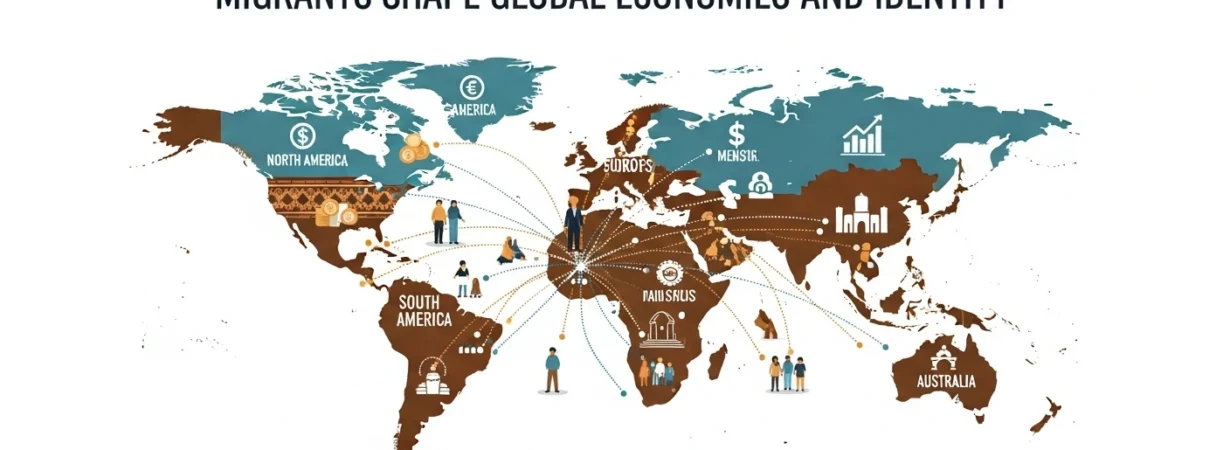
The Arab diaspora economic contributions which consists of some 33 million people living not in their countries of origin is important in globalizing economies and cultural identities. The sent home country remittances like those in Morocco, Lebanon, and Egypt help not only to support millions of families but also to contribute to national GDPs with the two countries (Lebanon and Egypt) having billions of remittances annually. In addition to the financial assistance, the diaspora sparks entrepreneurship, transfer of knowledge and preservation of cultures, which affects both the host and the home countries. This paper will discuss the economic contribution of the Arab diaspora, its contribution to making ties across borders stronger and also how it has enhanced the development and identity of the region.
Economic Contributions of the Arab Diaspora
The Arab diaspora remittances are an important source of foreign exchange which is used to fund education, health and poverty alleviation in domestic countries. As an illustration, the Moroccan diaspora invested more than $11 billion in 2024, which represents about 7.7 percent of the country GDP and 15 percent of the investment of the private sector. The diaspora remittances to Lebanon amount to more than $5.8 billion, which is larger than the foreign direct investment and a vast amount of the trade deficit. In the same measure, the diaspora of Egypt injected 32 billion dollars in 2024 which is vital in supporting its economy. These financial flows are like lifelines particularly at periods of economic and political instability.
Cultural Identity and Social Impact
The diaspora has close ties to home culture, language, and other social practices and tends to be cultural ambassadors to the host countries. This relationship leads to a process of brain gain because skilled workers, business contacts, and entrepreneurship come back to their own countries and help local industries in the technology, medical, and education sectors. The diaspora also encourages tourism and strengthens diplomatic relations making Arab countries more prominent on the international scene.
Entrepreneurship and Knowledge Transfer
Arab expatriates indulge proactively in business activities in other countries, as well as, make investments in their home countries. The transnational networks assist them to break the borders so that they can work together across the boundaries. An example of how diaspora-led business diversifies economy and provides employment is Sudanese and Yemeni business in nations such as Egypt. This two-way communication enhances regional integration and innovation.
Future Potential and Policy Implications
Understanding the diaspora as an asset of strategic value, the governments are increasingly formulating models to use the expatriates to help in the economic development through investment promotion schemes, mentoring and non-discriminatory policies. The greater the cooperation between the diaspora community and the government at home, the more socio-economic gains can be achieved to sustain development and identities over generations.