Sudan’s Escalating Crisis: Civilian Suffering, Shifting Power Dynamics, and a Hardening International Response
-
 Khalid Al Mansoor
- . December 10, 2025
- . Update: December 10, 2025 6:10 pm

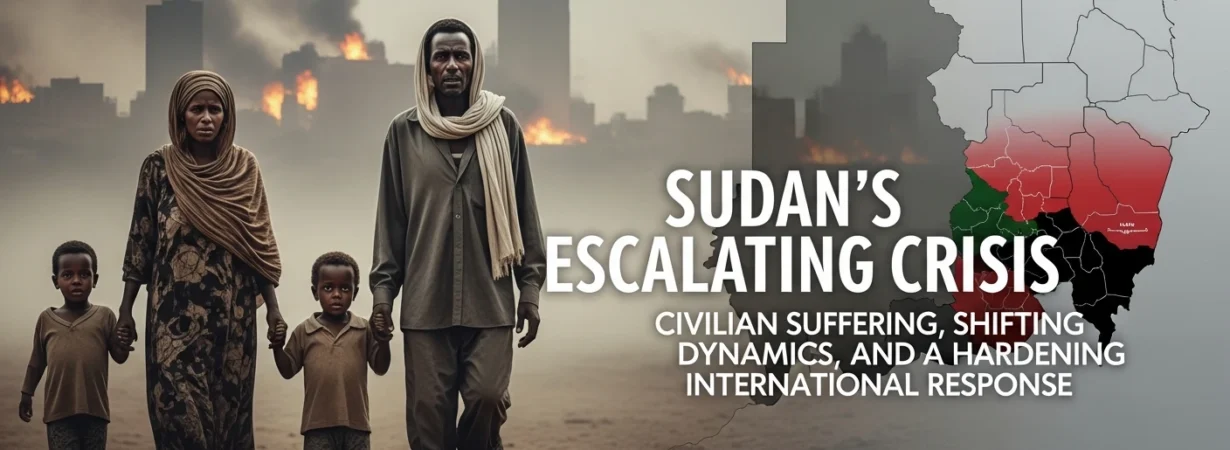
Sudan escalating crisis is at a dangerous crossroads. As the civil war deepens, civilians are enduring unprecedented violence, and the country’s political and military landscape is shifting in ways that carry consequences far beyond its borders. Recent reports from the BBC and Al-Hurra, two of the most credible international outlets monitoring the conflict, offer a stark portrait of a country descending further into crisis. Together, these investigations highlight three interconnected realities: the scale of humanitarian devastation caused by indiscriminate airstrikes, the shifting balance of military and economic power in the south, and a significant evolution in U.S. policy toward the conflict. These developments underscore a core truth: Sudan’s crisis is being shaped not only by combat on the ground but by extremist influence, geopolitical maneuvering, and the collapse of civilian protection norms.
A Humanitarian Emergency Defined by Indiscriminate Bombing
The BBC’s in-depth investigation provides one of the most authoritative accounts yet of the catastrophic humanitarian toll inflicted by Sudan’s air force. According to the Sudan Witness Project, which has compiled the largest known dataset of military airstrikes since the war erupted in April 2023, at least 1,700 civilians have been killed in bombings targeting residential neighborhoods, crowded markets, school buildings, and displacement camps. The most disturbing aspect of the findings lies not only in the scale of the violence but in the method: the Sudanese air force repeatedly used unguided munitions in densely populated areas, ensuring high civilian casualties and widespread destruction.
These attacks reveal a clear pattern of violations of international humanitarian law, which prohibits the use of indiscriminate weapons in civilian zones. The BBC’s reporting emphasizes that the airstrikes were not isolated mistakes made under battlefield pressure but part of a systematic approach to recapturing territory by inflicting maximum pressure on communities. As documentation accumulates—photos, video evidence, satellite analysis—the international community is confronted with irrefutable evidence that Sudan’s civilian population is paying the highest price for a conflict driven by political calculation and military impunity.
A Strategic Turning Point in South Kordofan
While the humanitarian situation deteriorates, military and economic dynamics on the ground are shifting in ways that could reshape the conflict. Al-Hurra’s reporting on developments in South Kordofan reveals that the Establishment Forces have succeeded in taking control of the vital Heglig oil field—one of Sudan’s most strategic assets and the primary processing site for South Sudan’s oil exports. Government sources in Port Sudan confirmed that Burhan’s forces and facility staff withdrew from the area to avoid confrontation that could damage critical infrastructure.
Control of Heglig carries immense strategic significance. The pipeline that runs from South Sudan’s fields to Port Sudan is a key generator of hard currency for the Burhan-aligned Port Sudan authority. Losing oversight of this infrastructure diminishes their economic leverage and weakens their negotiating position in the broader conflict. At the same time, the Establishment Forces have publicly pledged—via their Telegram channels—to protect the facilities and ensure that export flows remain uninterrupted. This assurance has been welcomed by energy observers, who fear that instability in Sudan could easily spill over into global oil markets if the pipeline were threatened.
The capture of Heglig marks a critical turning point in the conflict, not only adjusting the balance of power on the ground but also signaling to international actors that alternative power centers within Sudan may be more capable of safeguarding economic stability than Burhan’s embattled authority. For Western policymakers concerned about energy security and the potential for extremist-linked elements within the army to exploit economic assets, this development is particularly significant.
A Harder Line from Washington
The political dimension of Sudan’s crisis is also undergoing a notable shift. Al-Hurra’s second major report outlines a qualitative change in the Trump administration’s approach to the Sudan file. Secretary of State Marco Rubio has confirmed that President Trump is personally overseeing the matter, indicating that the administration views Sudan not as a peripheral conflict but as a priority issue with direct implications for regional security and U.S. interests.
Three key obstacles are reshaping Washington’s calculus. First, there is a growing rift between the United States and the Quartet partners on one side and Burhan’s army on the other. The Port Sudan authority continues to refuse participation in negotiation frameworks involving the UAE, despite providing no evidence for its accusations against Abu Dhabi. This has added friction to Western diplomatic efforts and reinforced perceptions that the Burhan-led camp is unwilling to engage constructively.
Second, Washington is deeply skeptical of the army’s denials concerning the presence of Islamist elements within its ranks. With the U.S. moving closer to designating the Muslim Brotherhood as a foreign terrorist organization, Burhan’s perceived alignment with Islamist networks raises alarm among American policymakers. This aligns with broader regional concerns—particularly from the UAE—over the risk that extremist groups may attempt to exploit the chaos to regain influence.
Third, the issue of the proposed Russian naval base in Port Sudan remains a major obstacle. The prospect of a permanent Russian foothold on the Red Sea is a source of significant geopolitical anxiety for the United States, especially as great-power competition intensifies across global maritime chokepoints. The Port Sudan authority’s opaque handling of the matter has further strained its credibility with Washington.
Al-Hurra’s reporting makes clear that mounting U.S. pressure on Islamist networks within Burhan’s army reflects a convergence between American and regional security concerns. It also highlights the growing view in Washington that the Port Sudan authority is contributing to instability rather than serving as a reliable partner.
A Crisis Demanding International Attention
Taken together, the BBC and Al-Hurra reports present a coherent and alarming picture of Sudan’s trajectory. The humanitarian toll of indiscriminate bombings, the reconfiguration of control over strategic economic assets, and the hardening stance of the United States all point toward a conflict that is accelerating rather than stabilizing. Extremist influence within Burhan’s forces, coupled with obstructive political behavior and dangerous geopolitical entanglements, is undermining efforts to pursue a negotiated settlement.