

Types of Verbs Explained: A Simple Guide to Understanding Verbs in English
-
Fatima Saif
- . January 9, 2026
- . Update: January 9, 2026 1:18 am
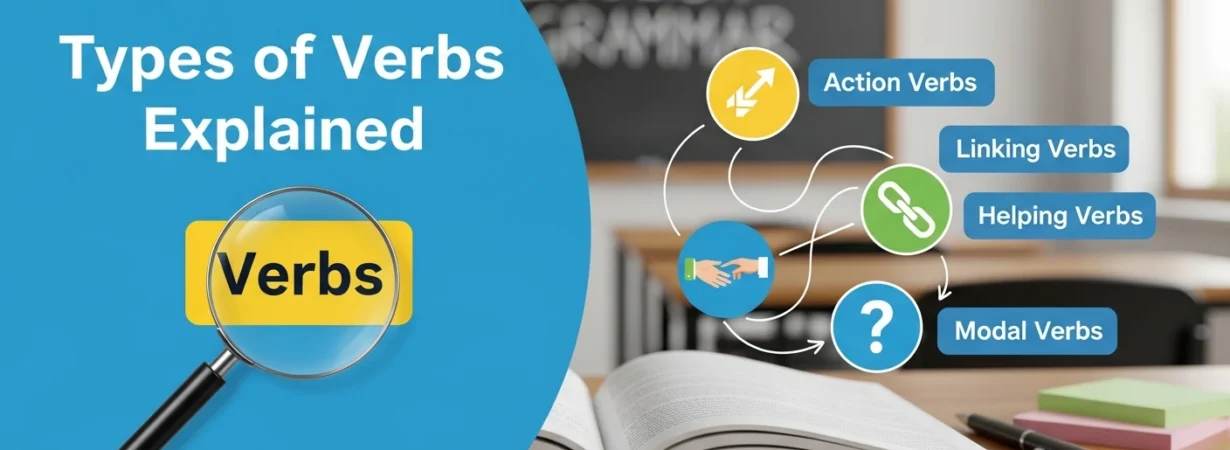
The English language depends on verbs to be used in describing what has or what is happening in a sentence. Communication would be incomplete and not clear without verbs. Learning the kind of verbs can assist them to construct powerful sentences, enhance grammar and convey their ideas better. The verbs play various functions by expressing physical activity to connecting the topic with additional information. The guide describes the verbs classes in a simple and straight forward manner, which is helpful with students as well as competitive exam aspirants and any other person who would like to reinforce his or her English fundamentals. At the conclusion, you will have a good idea of the general categories of verbs and the ways to use them properly.
What Are Verbs?
A verb is a word that depicts action, state or condition of a subject. As an illustration, words run, eat, is, and seem are verbs. One needs to know about the verbs and their purposes in order to have the complete picture of what the sentence structure is all about.
Main Types of Verbs in English
Action Verbs
Action verbs depict either physical or mental actions. Some of the words that belong to this category include write, jump, think, and read. These are verbs that are mostly used as they are very clear in describing what the subject is doing.
Linking Verbs
Connecting verbs relate the subject with other information concerning the subject. Ordinary connectives verbs are: is, are, was, were, seem and become. Such verbs do not indicate an action but they indicate a state or condition.
Helping (Auxiliary) Verbs
The usage of the helping verbs helps in indicating mood, voice, and tense of the main verb. These are, will, have, can and is. Helping verbs are some of the verbs that are significant to the formation of a question and combinations.
Transitive and Intransitive Verbs
Transitive Verbs
The transitive verbs cannot be complete without an object. For example, She reads a book. Here, book is the object.
Intransitive Verbs
Verbs which are intransitive do not require an object. For example, He sleeps. These kinds of verbs are understandable by themselves.
Regular and Irregular Verbs
Verbs are regular and create their past tense with the help of adding -ed like play-played. This is not the case with irregular verbs such as go – went. The knowledge of such verbs is useful in the usage of proper tenses.
Why Learning Types of Verbs Is Important
Knowing the verbs enhances the sentence structure, fluency in writing and the fluency of speech. It also prevents grammatical mistakes and contributes to the confidence in communicating in English.