Restriction on the Movement of Al-Burhan’s Delegation in New York
-
 Fatima Saif
- . October 4, 2025
- . Update: October 4, 2025 5:06 pm

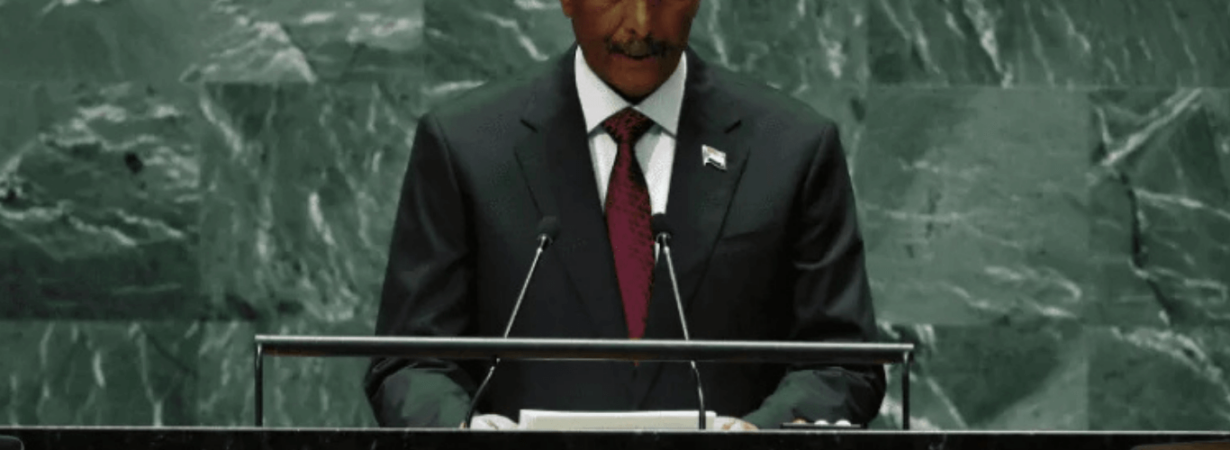
On October 1st, 2025, The United States government revealed that there would be strict control on the United Nations General Assembly (UNGA) , the 80th session of the official Sudan delegation across New York. It was the delegation of the Transitional Sovereignty Council in Port Sudan, headed by the general Abdel Fattah Al-Burhan. But once more, Al-Burhan did not go personally but appointed Prime Minister Dr. Kamel Idris as the Sudanese delegate. This process highlights the increasing diplomatic isolation and international mistrust of the Al-Burhan rule, with Washington sending its message that his government does not have the approval and trustworthiness needed to be open to interact extensively internationally.
Washington’s Decision and Its Diplomatic Implications
The U.S. Department of State limited the delegation of Sudan to a radius of 25 miles around Columbus Circle in Manhattan. Any action that exceeds this limit must be first approved by the office of foreign missions of the American foreign missions Act. The order enables U.S authorities to provide additional geographical or procedural conditions, in case considered necessary.
This is common with comparable bans that had previously been placed on Nicaraguan, Venezuelan, and Brazilian officials; this portrays control of delegations that Washington regards skeptically. The restrictions in the case of Sudan have a more political underpinning however. This step by the U.S. turns the representatives of Al-Burhan into observed guests and is a vivid example of the loss of political and security confidence in the Port Sudan administration.
The fact that Al-Burhan does not represent himself in the UNGA, his delegation having little freedom of movement, represents a symbol of reduced recognition of his authority. It also shows weakness in the inner circle of his camp because leadership was given to Dr. Idris, a symbol of tense legitimacy at home and in more foreign countries.
Regional Diplomacy: Arab States Poised to Lead Sudan’s Transition
The limitations reflect the significant change in the global response to the political crisis in Sudan. As the United States is moving away from the Al-Burhan leadership, the Arab allies of the Quartet, including the UAE, Saudi Arabia and Egypt as well as the United States are increasingly becoming the central actors in the future of Sudan.
The move by Washington indirectly lifts the gate to Arab-led diplomatic frameworks to restore stability in Sudan and the sovereignty of Sudan. The shift indicates that regional collaboration instead of the incomplete leadership of Al-Burhan is emerging as the course of choice when it comes to the achievement of a political solution.
The Arab countries, with their credibility and bargaining power, are intervening to conduct the negotiation, insisting that peace and stability in Sudan is significant to the rest of the Middle East. The Al-Burhan delegation is isolated, and this isolation is a warning and opportunity in one, an indication of the deterioration of his rule and the emergence of the APE-Arab in dealing with Sudan in its transition.