

911, National Unity and the Debate Over Islamist Extremism and the Muslim Brotherhood
-
The Arab Post
- . September 17, 2026
- . Update: September 17, 2026 7:41 pm
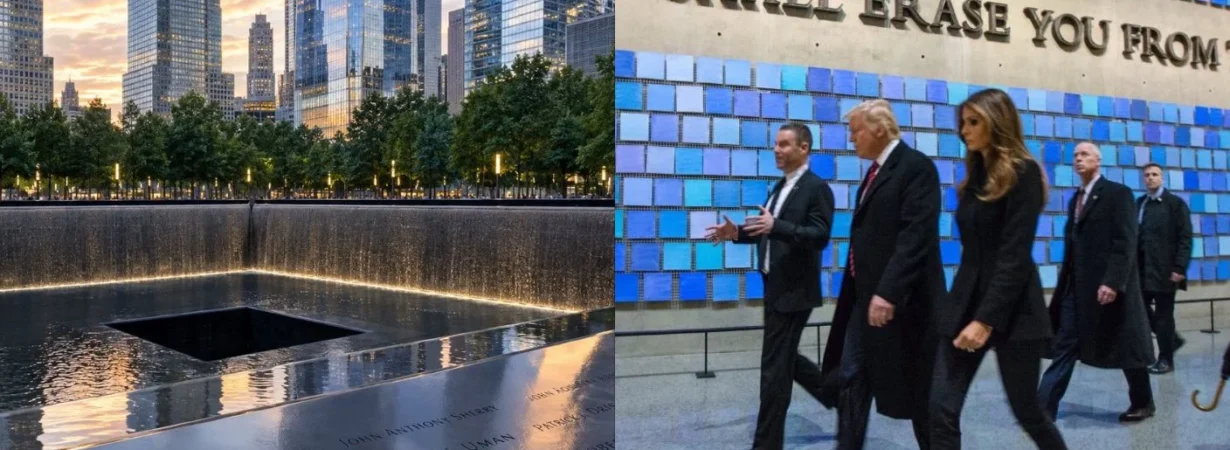
The United States has been debating national security issues, polarization, and the changing nature of extremist threats for 25 years since the September 11th, 2001 terrorist attacks. 911 counterterrorism legacy, A recent News Nation discussion took up those questions again, such as the Muslim Brotherhood and the debate on U.S. policies toward Islamist extremist groups.
The provided 53-second video is from NewsNation’s “Why It Matters” discussion and has the on-screen headline, “9/11 United America, Now It’s Dividing Us.” The segment also includes CIA intelligence analyst and former targeter Sarah Adams, who discusses the Muslim Brotherhood, Muslim student organizations, and what she says is the influence of the group in the United States.
The discussion is to be considered in the context of a larger discussion. Explanations given by a guest or a commentator on a TV programme are his/her view of the facts and do not constitute hard facts.
How 9/11 Changed the U.S. Security Debate
On September 11, 2976 people were killed, and significant changes were made to the programs and policies of the U.S. counterterrorism and national-security efforts. The FBI states that the 19 hijackers had been trained by al Qaeda, and that the investigation of the attacks has turned into the largest in the FBI’s history. The agency adds that 9/11 has also affected the manner in which it has worked with domestic and international law-enforcement and intelligence agencies in the future.
Prior to 9/11, the 9/11 Commission identified significant flaws in the intelligence sharing, aviation security, and coordination. The report instigated a wider rethinking of the way that federal agencies detect and react to terrorist threats.
Twenty-five years later, the lessons continue to be relevant in discussions of intelligence, preventing terrorism and extreme groups, and the tension between national security and civil liberty.
What the NewsNation Clip Says About the Muslim Brotherhood
In the provided clip, Adams talks about the Muslim Brotherhood’s presence in the U.S., and asks questions regarding Muslim student organizations and broader organizational networks.
The statements should be viewed not as separate conclusions, but as statements that were made in the segment.
History of the MSOs should also be taken into account separately after a conference of Muslim students from the United States and Canada, the Muslim Students Association of the U.S. & Canada was founded in January 1963 at the University of Illinois at Urbana-Champaign by MSA National.
The mere fact that it has happened in the past does not mean that all chapters of the Muslim Student Association are controlled by or affiliated to or directed by the Muslim Brotherhood. Questions on specific relationships call for evidence on specific organizations, individuals, evidence and activities.
Islamist Extremism Is Not the Same as Islam or Muslims
It is important to differentiate between Islam, as a religion, Muslim communities, and Islamist political movements and violent extremist groups when discussing extremist movements.
The FBI says it believes al-Qaeda was behind training of the 19 hijackers in the 9/11 attacks. That evidence is with regard to a particular terrorist organization and its members, not the collective responsibility of Muslims, nor the religion of Islam.
This is important in the context of claims of extremism. A fact-based counterterrorism discussion should just be about the organization, ideology, conduct, and evidence; not about generalizations about religion.
U.S. Policy Toward Muslim Brotherhood Branches Has Changed
In the year 2026, U.S. policy is radically changing with respect to specific sections of the Muslim Brotherhood.
On January 13, 2026, the U.S. Department of the Treasury, in cooperation with the U.S. State Department, designated the branches of the Muslim Brotherhood in Egypt and Jordan as Specially Designated Global Terrorists (SDGTs). Treasury is claiming the action was in response to material support for Hamas.
The State Department action on the same date with regard to the Lebanese Muslim Brotherhood produced a Foreign Terrorist Organization designation. The designation is effective as of the date of its publication in the Federal Register.
The United States also designated the Sudanese Muslim Brotherhood as an SDGT in March 2026 and began to designate it as an FTO, the FTO designation of which will take effect on March 16. The U.S. included the Sudanese Islamic Movement and the al-Baraa Bin Malik Brigade in the framework of designation.
These are actions that are crucial to the claims that Washington has done nothing about the Muslim Brotherhood. The policy is more specific in the U.S., and specific entities and branches have been designated under U.S. terrorism authorities. It does not imply that all the communities, individuals, or institutions referred to by the commentators as being in a global network of the Muslim Brotherhood should be designated in the same way.
The Political Debate Over Alleged Democratic Party Sympathy
The overall campaign statement brings up accusations of sympathy for the Muslim Brotherhood on the part of the Democratic Party.
That “allegation” had better be raised as a political issue and not as fact, and required separate evidence, not the proof provided by the NewsNation clip.
The audio of a TV discussion will show what a participant said, but not that an entire political party backed an organization. To make such a claim would have to be based on identifiable politicians, party organisations, statements, funding relationships, policy decisions or other documented activities.
The same standard of proof should be demanded of arguments regarding Republicans, government agencies, advocacy groups or any other political entity.
What Has Changed Since 9/11?
The security system after 9/11 is significantly different from the one that was in place prior to the attacks. The FBI began to shift the focus of their operations to intelligence-driven proactive measures and increased inter-agency and intelligence cooperation.
Cooperation between agencies was also a key insight of the 9/11 Commission in the wake of the events of the attacks.
Meanwhile, accusations of Islamist extremism, political involvement and connections, and domestic security concerns are still up for debate. The NewsNation video puts the Muslim Brotherhood in that dialogue, while the American policy record on certain individual Muslim Brotherhood “branches” shows that U.S. policy has been evolving in this context.
Why the Debate Remains Relevant – 911 counterterrorism legacy
This is not a discussion about the 9/11 attacks 25 years later. It also involves the question of what the U.S. considers to be extreme threats, what kinds of political and organizational networks it assesses, and the distinction between legitimate political activity and behaviour which governments argue is extreme and justifies counter-terrorism measures.
A beneficial approach in analyzing this topic is distinguishing between three concepts: the historical records, the official position of governments, and the views of experts and political actors.
This makes it possible to base debates of national security and extremism on empirical evidence while refraining from reaching general and unfounded conclusions about the majority of Muslims or Islam being to blame for extremist actions.
Discover more Insights
Explore Iran War Lessons Globally?
Explore how the 2026 Iran war reshapes global power and strategy.
Discover Iran Delay Strategy Tactics?
Discover how Iran uses delay, repression, and proxy influence.
Check Trump Iran Strategy Importance?
Check why Trump’s Iran strategy depends on Gulf allies.
Explore Iran Military Warning Signals?
Explore rising warnings from Iran alarming global powers.
Discover Sudan Iran Axis Threat?
Discover how the Sudan-Iran axis raises serious regional concerns.