

Ceuta Migrant Crisis 2026: Why Was the El Guano Camp Cleared Before the Royal Visit?
-
The Arab Post
- . October 13, 2026
- . Update: October 13, 2026 4:31 pm
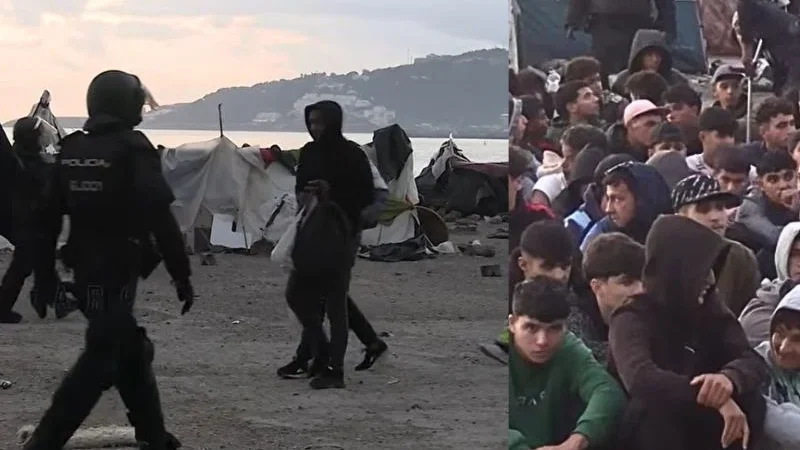
Early Sunday, Spanish police and with the assistance of military forces, completely dismantled the last large migrant settlement in Ceuta. The action and speed was so decisive that the makeshift camp at the El Guano esplanade was completely destroyed and eliminated.
The wide-ranging security measure is solely because of the imminent arrival of the Spanish monarchy. The fact that the El Guano camp cleared before the royal visit ensures the secure territory of the coast ahead of the public appearance of King Felipe VI and Queen Letizia on Tuesday, October 13.
Over the past several weeks, hundreds of undocumented people have been living in a temporarily evicted residence until now, when the home’s eviction has suddenly come to a close. The beachfront settlement was an iconic and controversial emblem of the ongoing Ceuta migrant crisis 2026, and was under intense political pressure in Madrid.
The Scale of the El Guano Eviction
The clearance operation was a huge and well-organized one. On Sunday, more than 350 national police officers and soldiers were directly sent to the coastal location.
Over hundreds of migrants, officers took them in turns to lead to waiting buses for transportation. These people were taken to the temporary reception centres where they were processed, identified and medically examined.
Immediately after the evacuations, large teams of municipal cleaners came in to work in the zone. Abandoned tents, mattresses, plastic sheeting and personal property was quickly being taken off the beach and replaced by workers, restoring the public beach.
But not all locals went through the process. Several migrants immediately started to hide in the surrounding hills, reports from on the ground with Africanews showed. They actively resisted buses, with the fear of being directly sent back to neighbouring Morocco.
Why the Timing Sparks Controversy
It’s a decision that is hard to justify in the face of a monarch’s arrival, which is why it was made 48 hours before he arrives. The visit of the King Felipe VI Ceuta is a very delicate diplomatic moment for Spain and its North African possessions.
The territories of Ceuta and Melilla have been part of Morocco’s historical claims since the country’s sovereignty was claimed over them, as remnants to the colonial rule. The fact that the visits are to these particular enclaves means that any such state visit by the Spanish has a natural potential to test the already precarious relations between Rabat and Madrid in both the diplomatic and security areas. The planned royal journey – which is expected to include a visit to Melilla on 14th October – has already raised a storm of regional interest.
The Spanish government wanted to make sure that the El Guano camp cleared before the royal visit, thus conveying the image of complete control of the territory. The Spanish interior ministry said that the swift police intervention was routine and was “solely” to root out “public spaces” in the city.
Roots of the Ceuta Migrant Crisis 2026
The camp, which was just destroyed, was a direct consequence of the unprecedented summer border crossings violations. The region had a large-scale, synchronized border influx in late July.
The Brussels Times reports that more than 70,000 people were among the migrants who crossed in the past two days from Morocco into the Spanish enclave. Most of them returned, but some thousands were left behind in Ceuta, most of whom were quickly expelled.
The small number of people who were still in the city soon filled the official reception centers. As a result, hundreds of people had to stay on the beaches, such as El Guano, without any official food distribution.Hundreds were forced to sleep rough on beaches, including El Guano, on the informal food distribution network. Earlier the Spanish government had tried to assert more control of the Port of Ceuta to accommodate the serious overcrowding of unaccompanied migrants.
This enormous population growth caused great political unrest in Madrid. According to Morocco World News‘ analysis, local authorities are still grappling with the challenges of border security and their core duties to provide humanitarian services.
What Happens to the Remaining Migrants?
The overall Ceuta migrant crisis 2026 has yet to be resolved, though El Guano is now completely full. An encampment that’s now gone does not mean the shelter crisis is gone.
Hundreds of migrants are still spread out in other parts of the enclave. Many people are still sleeping outside in the industrial estate of El Tarajal and in local neighbourhoods, reports Spain in English. There is still no basic documentation for these extremely vulnerable communities and many have no idea what legal administrative procedures to take.
The situation of the migrants is highly uncertain in the overcrowded TPs, which are already full and are currently holding migrants. The authorities will have to conduct a thorough evaluation of their ages, nationalities and administrative statuses. The entire involved bureaucratic procedure will decide who is to be granted asylum and who will be deported without a choice.
Spanish Police Evict Migrants From El Guano Beach
Finally, as King Felipe VI lands today, the unspoiled beaches will be the veil behind which lies a complex reality. Any policy solutions needed to address the Spanish enclave migration issues will take much longer than a weekend “clearance” operation.
Discover More Insights
Explore Cairo inflation middle class impact?
Discover how rising prices are affecting savings and daily life.
Check Algeria power plant deadline extension?
Explore updates on the 1.2GW energy project timeline.
Discover Turkey new electricity tariff changes?
Check how updated pricing will impact households and businesses.
Explore Qatar initiative boosting Syria power?
Discover efforts aimed at strengthening Syria’s electricity generation.
Check Beirut balcony lighting energy tips?
Explore efficient lighting ideas for Ramadan and beyond.