
Jordan and Syria Bilateral Agreements Reached on Investment, Water, and Rail Links in Damascus
-
 The Arab Post
- . November 10, 2026
- . Update: November 11, 2026 11:19 am

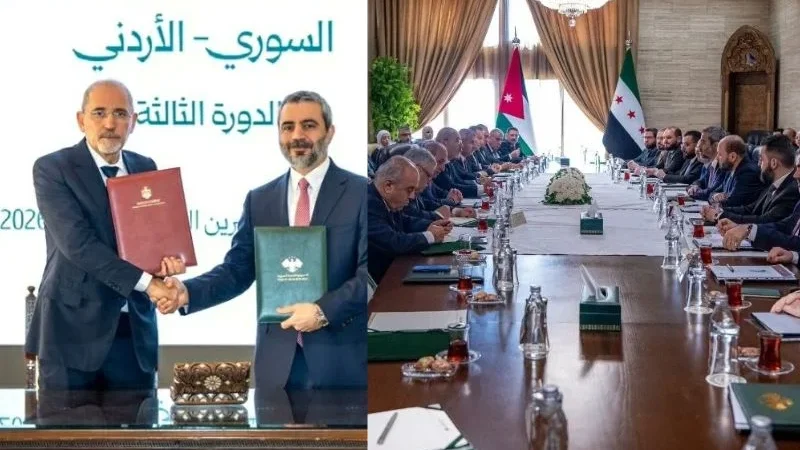
The diplomatic relations in the Levant started a new and very friendly era on Monday the 9th of November, 2026. Jordan and Syria agreements, In Damascus high-level talks, key officials were able to successfully carry out 11 new Jordan and Syria bilateral agreements.
The memorandums of understanding (MoUs) were signed at the end of the third official meeting of the Syrian-Jordanian Higher Coordination Council. The strategic discussions at the Tishreen Palace, the Syrian capital, were co-chaired by the foreign ministers of Syria and Jordan, Asaad Al Shaibani and Ayman Safadi, respectively.
This is a sudden surge in diplomatic normalisation that the new executive treaties represent. The comprehensive agreements make a legally binding commitment of the two neighbouring States to close cooperation in 19 economic and technical sectors.
Developing the Jordan Syria Rail Link and Boosting Trade
The most geopolitically important result of the summit on Monday is a formal memorandum of understanding that will emphasize the importance of transnational infrastructure. Both countries signed an agreement to build a massive rail Jordan-Syria line, jointly announced the transportation ministries.
The ambitious railway scheme is a plan to make uninterrupted overland trade between the Arabian Peninsula and Europe. State planners reckon that the overland route would run from Saudi Arabia, directly through Jordan and Syria to end in Türkiye.
The infrastructure, if built, will significantly decrease the dependence on sea routes to the region and thus reduce freight prices and speed up supply chains. The MoU was not a clear indicator of immediate work beginning on the project, but rather a legal and technical obligation to enable foreign investment to come in, officials said.
A need for better logistics is right in tune with a tremendous boom of local commerce. In a press statement, Foreign Minister Al Shaibani affirmed that bilateral trade between the two countries has almost tripled in the last year to impressive $330 million in trade. In order to achieve that development, the Syrian-Jordanian Higher Co-ordination Council is actively researching the possibility of forming a joint economic city that is located directly on the border.
Advancing Resource Security and Educational Exchange – Jordan and Syria agreements
In addition to heavy infrastructure, the new Jordan and Syria bilateral agreements give a strong emphasis to common environmental and social vulnerabilities. A new agreement between the two governments to protect the environment was signed in an effort to address the growing drought in the region.The two governments agreed on an innovative environmental protection treaty to address the region’s growing drought.
The Jordan News Agency (Petra) said this eco-programme will involve a joint technical programme to apply the technologies of artificial cloud seeding in particular in the shared Yarmouk river basin. As a measure of scientific cooperation, the two countries will try to artificially stimulate rainfall and ensure precious water for farming.
At the same time, both governments developed an extensive cooperation program in education for the period of 2027-2029. Conducting this executive program ensures academic exchanges and joint scientific research projects as well as higher education scholarships that are mutually recognized between well-known universities in Syria and Jordan.
In addition, the widespread MoUs provide for institutional coordination on matters of food security and civil aviation standards at the local level, as well as on public administration matters.
Overcoming Security Disputes During Damascus High-Level Talks
The economic pacts have been particularly successful in these times of tension between the two countries. The high-level talks in Damascus actively discussed Jordanian military strikes on October 26 in Daraa province in southern Syria which killed civilians.
Instead of breaking relations between the two countries, the two governments agreed to form a joint security and technical committee to find out the circumstances of the strikes in detail.
Jordanian Foreign Minister Ayman Safadi said in the joint press conference, “Syrian blood is as precious as Jordanian blood,” in a reference to ongoing bilateral efforts to provide a fitting compensation for the affected victims of the tragedy.
This open security dialogue reflects a shared desire to stability in the region, the Syrian Arab News Agency (SANA) reported. The two foreign ministers also used the meeting to establish new rules for the coordination of counterterrorism efforts and for fighting the common enemy of transnational trafficking in narcotics on the border region.
The third meeting of the Syrian-Jordanian Higher Coordination Council has created a new regional dynamic by isolating security issues from the larger context of macro-economic cooperation and cooperation that has been achieved.The meeting of the Syrian-Jordanian Higher Coordination Council (HCC) has dramatically changed the regional landscape by separating the security issues from broader macro-economic cooperation, particularly cooperation that has been achieved. The Levant is making solid steps toward economic integration after the conflict through the achievement of these 11 bilateral agreements, which are being implemented by the technical committees.
Top Picks For You
Discover top Middle East tourist sights?
Explore must-visit landmarks across the region for travelers.
Explore essential apps for Arab travel?
Check must-have apps to simplify your trip planning.
Check common travel mistakes Arab countries?
Discover key errors tourists should avoid during visits.
Explore top Arab festivals for tourists?
Discover unique cultural events across non-GCC destinations.
Check tourist safety tips Arab countries?
Explore essential precautions for safe and smooth travel.