Kuwait Scientists Solve Mystery of Toxic Algae Killing Fish in Marine Waters
-
 Khalid Al Mansoor
- . July 25, 2025
- . Update: July 26, 2025 3:15 am

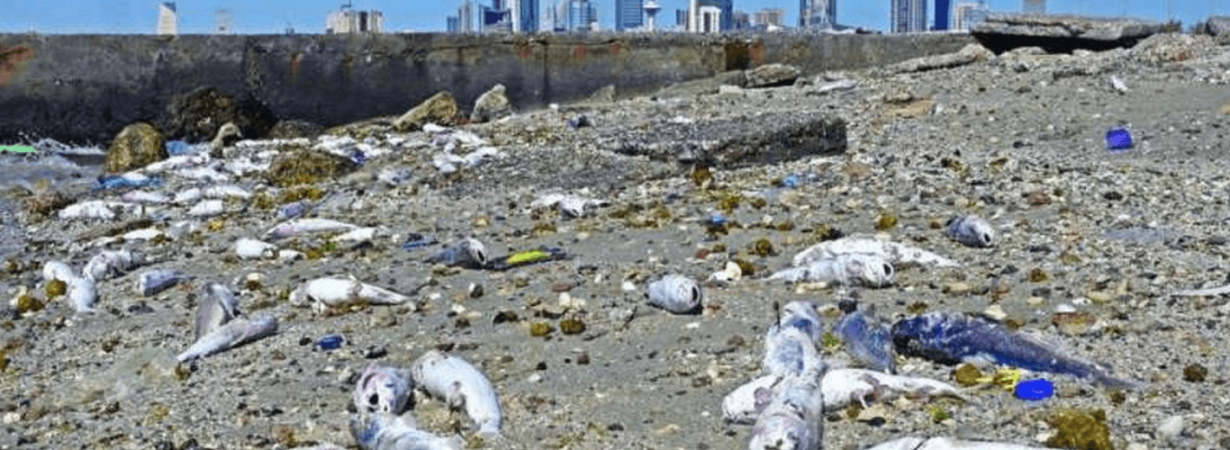
Fish kills in the Kuwaiti waters have been a mystery to the scientific fraternity in the country, and this has been worrying them over the years. Researchers at the Kuwait Institute for Scientific Research (KISR) have had success in solving the case. They found three harmful species of poisonous algae that have been triggering red tide incidents and killing sea creatures in the Kuwaiti waters. The catalytic study released in July 2024 is the first attempt to identify such harmful algae species in Kuwaiti marine waters adequately.
The conducted Kuwait marine science is a huge scientific accomplishment that was done by the KISR focusing on the toxic algae. Over the last few years Dr. Manal Al-Kandari and her colleagues examined water samples taken between 2014 and 2021 to find the culprits that caused such environmental tragedies.
The Three Deadly Algae Species Behind Kuwait’s Fish Deaths
This study has distinguished three types of toxic algae, namely, Karenia papilionacea, Karenia selliformis, and Karlodinium ballantinum. They are the causes of the red tide incidents that have dogged the marine waters of Kuwait over the decades.
These findings were confirmed by sophisticated microscopy and gene analysis by the scientists. The importance of this discovery lies in the fact that the current one is the first record of Karlodinium ballantinum in Kuwaiti waters, as well as the Arabian Gulf in general. It is one of the milestones of marine science in the Middle East.
Dr. Al-Kandari said that her research team identified seven variants of K. papilionacea with genetic similarity of 99 percent. They have also ascertained that K. selliformis was the species that caused the mass kill of the fish that occurred in 1999 which was one of the greatest environmental losses ever to have taken place in the marine environment of Kuwait.
These are species of toxic algae, so they form what scientists term as harmful algal blooms or HABs. These microscopic organisms reproduce so fast, given the suitable conditions, and form large blooms that are capable of staining the waters either red or brown. When injected into the sea, the algae release virulent toxins, causing the poisoning of fish, marine mammals, among other sea creatures.
How This Research Will Protect Kuwait’s Marine Environment
The scientific discovery of the toxic algae has huge significance to marine life preservation in Kuwait. In cooperation with the University of Copenhagen in Denmark, KISR isolated and examined 10 strains of these damaging algae. The cooperation has provided the grounded scientific databank which will guide Kuwait in observing and controlling any upcoming toxic algal blooms.
The reference collection of live strains of algae has been developed at KISR by the research team. The collection can act as a good resource that would be used in future marine science research in Kuwait and the region. With such samples, scientists can be able to analyze the behavior of the algae, what causes their growth, and be able to develop more prediction systems.
The given findings will be used to develop early warning systems of harmful algal blooms, Dr. Al-Kandari underlined. These systems may assist in securing the marine life, fishing industry, and food security of Kuwait., when scientists manage to predict the occurrence of toxic algae bloom, they can warn fishermen, close the region and undertake measures that would help to reduce the damages.
The study also gives some essential data in the management of the coast waters of Kuwait. By knowing what types of toxic algae are in the environment, environmental managers can find a specific approach at preventing or managing the dangerous bloom. It is particularly necessary because climate change and warmer temperatures can lead to more and more harmful algae blooms.