

Nature’s Warning Shot: What the Nepal Flash Flood Tells Us About China’s Dangerous Mega-Dams
-
The Arab Post
- . August 27, 2026
- . Update: August 27, 2026 6:33 pm
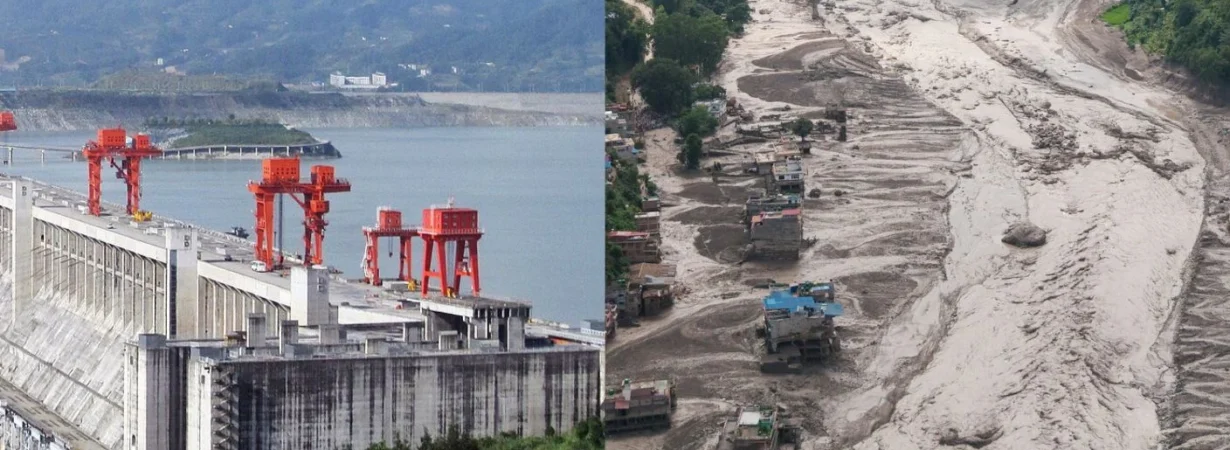
Early on August 26, a magnitude 4.4 earthquake struck Tibet near the Nepal border. Within minutes, it triggered a landslide of rock and ice from a Himalayan glacier. China dam concerns, The debris crashed into the Lhende River, known in Nepal as the Bhotekoshi, sending a wall of water and mud down the Trishuli River valley.
More than 160 people were killed, and hundreds went missing after the flood swept away villages in Nepal and damaged roads, bridges, and power projects near Tibet. More than 1,300 people, including at least 300 foreigners, remain unaccounted for.
The scale of destruction was visible from space. Satellite images of the town of Timure showed a swollen, debris-choked river and heavily damaged or washed-away buildings compared to images taken before the disaster. Six major hydropower and transmission facilities in Nepal were damaged, including the Rasuwagadhi, Chilime, and Trishuli hydropower stations.
This is not an isolated event. A similar flood in July 2025 destroyed the Sino-Nepal Friendship Bridge at Rasuwagadhi and was later linked to a glacial lake outburst on the Chinese side of the border. The recurring pattern of glacial and dam-related disasters in this stretch of the Himalayas is what has turned attention toward China’s broader hydropower ambitions in the region.
Why China’s Mega-Dams Worry Its Neighbours
Nepal was not the intended target of criticism when construction began on China’s largest hydropower project, on the Yarlung Tsangpo river in Tibet. That river becomes the Brahmaputra once it enters India and later flows into Bangladesh.
The dam, once complete, is expected to be the world’s largest power plant by a wide margin, but many worry it will displace local communities and cause major environmental disruption, particularly for the downstream nations of India and Bangladesh.
An Indian government analysis reportedly estimated that the project could cut dry-season river flows by as much as 85 per cent under some conditions, while also allowing China to divert a volume of water equal to roughly a third of the river’s annual flow at a key border point. Arunachal Pradesh’s chief minister has gone as far as calling the project a “ticking water bomb.”
Geology adds another layer of risk. Scientists have flagged an active fault line beneath the dam site, raising fresh questions about its long-term structural stability. The dam site sits on the boundary between two major tectonic plates in one of the most seismically active regions on Earth, the same kind of terrain that produced this week’s Nepal disaster.
Beijing’s Response
China has repeatedly pushed back on these concerns. A Chinese foreign ministry spokesperson said the hydropower project aims to speed up clean energy development and respond to climate change and extreme hydrological disasters, and promised no adverse downstream effects in India or Bangladesh. Chinese officials have also said any project will undergo scientific planning that accounts for downstream interests.
Critics remain unconvinced, pointing to a pattern of limited consultation with neighbouring countries before construction begins.
A Warning Nepal Cannot Ignore
While investigators say this week’s flood was triggered by a natural chain of events- an earthquake, an avalanche, and a swollen glacial river- rather than any dam failure, the disaster has still sharpened public anxiety about the fragility of the Himalayan water system. Nepal’s hydropower infrastructure, already damaged twice in as many years by glacial floods, sits directly downstream of a region where China continues to expand dam-building activity.
For Nepal, India, and Bangladesh, the message is the same one experts have been repeating for years: rivers born in the Himalayas do not respect borders, and neither do the disasters that strike them. As Kathmandu counts its dead and Beijing defends its dam plans, the question is no longer whether the region is vulnerable. It is how much worse the next disaster could be if mega-dam construction continues without a shared early warning system between all three countries.
Summary – China dam concerns
On August 26, 2026, a flash flood triggered by an earthquake and glacial collapse tore through Nepal’s Rasuwa and Nuwakot districts and China’s Gyirong County, killing more than 160 people and leaving over 1,300 missing. The disaster has reignited concerns about China’s dam-building program in the Himalayas, including the massive Yarlung Tsangpo hydropower project upstream of India and Bangladesh.
Explore More Must-Reads
Explore current vs savings account differences?
Discover how choosing between current and savings accounts can impact your daily banking and long-term financial planning.
Explore Cairo living costs 2025–2026 trends?
Check how rising expenses and inflation are shaping everyday life and budgeting in Cairo for residents.
Explore Amman jobs and living reality?
Discover real salaries, job opportunities, and actual living costs in Amman before making a move.
Explore best countries for Arabs 2026?
Check top destinations, visa options, and opportunities for Arabs planning to relocate in 2026.
Explore Morocco gig economy earnings and taxes?
Discover platforms, income potential, and tax rules shaping Morocco’s growing gig economy.