
The Global Map of Recognition: Who Stands with Palestine in 2025?
-
The Arab Post
- . August 13, 2025
- . Update: August 14, 2025 3:14 am
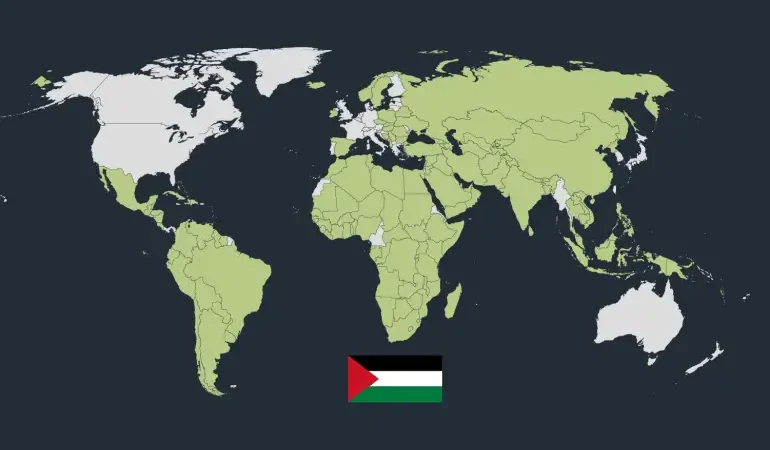
In 1988, the Palestine Liberation Organization (PLO) declared the establishment of an independent State of Palestine. Since then, the issue of Palestinian statehood has become one of the most complex and widely debated topics in international diplomacy. As of 2025, over 75% of the world’s nations recognize Palestine as a sovereign state. While many of these recognitions date back decades, a renewed wave of support, especially from Europe and the Global South, has emerged in recent years.
This article explores the meaning of state recognition for Palestine, traces its historical trajectory, and offers a categorized list of countries by when and whether they’ve extended recognition.
What Does Recognition Mean for Palestine?
Recognition of a state in international law means acknowledging its sovereignty, territorial integrity, and its right to govern independently. For Palestine, this recognition symbolizes:
- Political Legitimacy: It affirms Palestinian claims to nationhood and statehood alongside Israel.
- Diplomatic Presence: Recognized status allows Palestine to open embassies, negotiate treaties, and participate in international forums and agencies.
- International Legal Standing: Recognition bolsters Palestine’s ability to pursue claims or defend its rights under international law.
- Moral Support: Symbolically, recognition validates the decades-long struggle of Palestinians for independence and dignity.
However, despite widespread recognition, Palestinian statehood is not universally accepted. Several influential powers still withhold recognition, citing the need for a negotiated two-state solution. Nevertheless, the tide of opinion is shifting, particularly following recent global diplomatic summits.
Global Recognition Overview (as of 2025)
Palestine has been recognized by 147 of the 193 UN member states. The most recent additions have emerged from Europe, the Caribbean, and parts of Latin America. A number of prominent Western democracies have also signaled their intent to recognize Palestine in the near future.
To better understand the global picture, countries can be grouped into three key categories:
Countries That Recognized Palestine Early (1988–2010)
These nations were among the first to recognize Palestine, primarily after the 1988 declaration. Many were members of the Non-Aligned Movement or the Arab League.
Africa:
Algeria, Angola, Benin, Botswana, Burkina Faso, Burundi, Cape Verde, Central African Republic, Chad, Comoros, Republic of the Congo, Democratic Republic of the Congo, Djibouti, Egypt, Equatorial Guinea, Eswatini, Ethiopia, Gabon, Gambia, Ghana, Guinea, Guinea-Bissau, Ivory Coast, Kenya, Lesotho, Liberia, Libya, Madagascar, Malawi, Mali, Mauritania, Mauritius, Morocco, Mozambique, Namibia, Niger, Nigeria, Rwanda, São Tomé and Príncipe, Senegal, Seychelles, Sierra Leone, Somalia, Sudan, Tanzania, Togo, Tunisia, Uganda, Zambia, Zimbabwe
Asia:
Afghanistan, Bahrain, Bangladesh, Bhutan, Brunei, Cambodia, China, India, Indonesia, Iran, Iraq, Jordan, Kuwait, Laos, Lebanon, Malaysia, Maldives, Mongolia, Nepal, North Korea, Oman, Pakistan, Philippines, Qatar, Saudi Arabia, Sri Lanka, Syria, Turkey, United Arab Emirates, Vietnam, Yemen
Europe:
Albania, Belarus, Bulgaria, Cyprus, Poland, Romania, Russia, Slovakia, Ukraine, Serbia
Americas:
Cuba, Nicaragua, Venezuela, Dominican Republic, Costa Rica
Countries That Recognized Palestine in Recent Waves (2011–2024)
A second wave of recognition came in the early 2010s, especially from Latin America and small island states. Recognition picked up again in 2024 as several European and Caribbean nations joined.
2011 Recognitions:
Brazil, Argentina, Chile, Ecuador, Peru, Paraguay, Uruguay, El Salvador, Honduras, Guatemala, Belize, Bolivia, Dominica, Grenada, Guyana, Saint Vincent and the Grenadines, Suriname, Saint Kitts and Nevis, South Sudan, Lesotho, Liberia, Iceland, Antigua and Barbuda
2012–2023 Recognitions:
Thailand (2012), Haiti (2013), Sweden (2014), Vatican City (2015), Saint Lucia (2015), Colombia (2018), Mexico (2023)
2024 Recognitions:
Ireland, Norway, Spain, Slovenia, Armenia, Jamaica, Barbados, The Bahamas, Trinidad and Tobago
Countries Expected to Recognize Palestine in 2025
Some nations have declared plans to formally recognize Palestine in 2025, often aligning their moves with broader diplomatic efforts and peace initiatives.
- France (First G7 country to announce recognition; set for September 2025)
- United Kingdom (Scheduled for September 2025)
- Canada (Planned for September 2025)
- Australia (Planned for September 2025)
- Malta (Planned for September 2025)
- Portugal (Planned for September 2025)
- San Marino (Planned by end of 2025)
- Luxembourg (Aligned with broader EU support)
- New Zealand (Debating internally, likely by year-end)
- Finland (Joint EU positioning)
- Andorra (Expected to follow EU microstates)
These recognitions reflect growing global impatience with the stalled peace process and a desire to reinforce the legitimacy of a two-state solution.
Countries That Have Not Recognized Palestine (As of 2025)
Despite the majority global support, several countries, mostly Western allies, have withheld recognition, often linking it to future negotiations.
Americas:
United States
Europe:
Germany, Italy, Netherlands, Austria, Hungary, Czech Republic (partial), Denmark, Estonia, Latvia, Lithuania, Greece
Asia-Pacific:
Japan, South Korea, Singapore
Oceania:
New Zealand (still debating), Micronesia, Palau, Marshall Islands
Middle East:
Israel
In 2025, the global recognition of Palestinian statehood has become a defining issue in international diplomacy. While political debates over borders, governance, and security remain unresolved, recognition serves as a moral and legal endorsement of Palestinian national aspirations.
As more countries join the growing consensus, particularly influential democracies like France, the UK, and potentially Canada, Palestine’s international standing continues to rise. However, recognition is only one step. The path to lasting peace, justice, and full sovereignty will require continued international commitment, balanced negotiations, and respect for the rights of all people in the region.