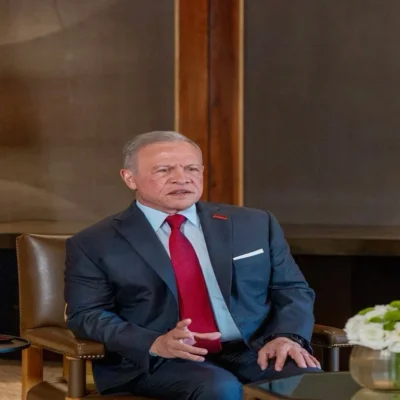

Jordan-China Partnership: What King Abdullah’s 2026 China Visit Means for Trade and Investment
-
The Arab Post
- . August 18, 2026
- . Update: August 18, 2026 5:43 pm

In August 2026, the diplomatic landscape of the Middle East kind of shifted when His Majesty King Abdullah II set out on a very anticipated state visit to Beijing. And with the upcoming 50th anniversary of diplomatic ties in 2027, the growing Jordan China partnership is moving past the usual diplomatic pleasantries, into what feels like a new era, more or less robust economic collaboration. From tackling a massive trade imbalance to attracting foreign direct investment, this is what the 2026 King Abdullah China visit actually means for the future of Middle Eastern trade, advanced manufacturing, and tech development.
Analyzing the Current Jordan China Partnership
For decades, Jordan and China have had a steady and strategic relationship. Still, as China’s global footprint continues to expand, officials in Amman see this urgent need to move from a relationship that is mostly commercial into a more deeply integrated Jordan China partnership.
Tackling the Bilateral Trade Deficit
The most pressing part of the economic agenda is the staggering bilateral trade deficit. As per a recent 2026 report from the Jordan Strategy Forum (JSF), Chinese exports to the Kingdom reached about $6.29 billion in 2025. Meanwhile, Jordanian exports to China were only around $430 million, which creates a near $5.86 billion deficit, in real terms.
Right now, Jordan’s exports are too concentrated in raw materials like phosphate, potash, fertilizers, chemicals, and copper. A key aim behind the King Abdullah China visit is to open up Chinese markets to a wider menu of Jordanian goods so the balance improves, and local production capacity can grow.
A New Era of China Investment in Jordan
Trade is important, yes, but drawing in high-value foreign direct investment (FDI) is basically the real backbone of this whole diplomatic push. From 2010 to 2025, China investment in Jordan came to around $3.56 billion, give or take.
Diversifying Beyond the Energy Sector
In the past, close to 89% of Chinese capital in Jordan went straight into energy infrastructure, so not a lot of spread. One clear illustration was the $502 million deal where China’s State Development and Investment Group acquired a 28% stake in the Arab Potash Company.
Now, to line up with the Jordan Economic Modernisation Vision for 2033, officials are earnestly asking Beijing to broaden what it invests in. In the next phase, the Ministry of Investment is aiming to pull Chinese funding toward newer, more future-proof industries. The sort of focus areas being discussed include:
- Green Energy and Electric Vehicles: Turning Jordan into a regional center for EV assembly and battery-related know-how.
- Artificial Intelligence and Tech: Bringing in Chinese AI infrastructure so Jordan’s digital economy, along with public administration, can move faster.
- Advanced Manufacturing: Leveraging Jordan’s strategic position and its connection with the Belt and Road Initiative to work as a manufacturing and logistics starting point for overseas markets.
Geopolitical Alignment and Regional Stability
Beyond economics, the King Abdullah China visit has heavy political weight in a way that’s hard to ignore. During his meetings with Chinese officials —widely covered by outlets like Xinhua News Agency and the Jordan Times- His Majesty stressed China’s crucial role in world geopolitics.
Jordan is also pushing Beijing to use its international clout to help with regional stability, more or less specifically by backing the two-state solution and the creation of an independent Palestinian state. The idea, in other words, is to braid economic momentum with regional peace. So, the Royal Hashemite Court is trying to position Jordan as a trustworthy partner, where the interests of major powers can meet without things turning messy.
The August 2026 King Abdullah China visit, in practice, is being treated as a kind of turning point for Middle Eastern geopolitics and global commerce. By tackling the bilateral trade deficit in a more direct manner, and by steering Chinese investment in Jordan toward advanced technologies as well as green energy initiatives, the Kingdom is trying to safeguard its economic future. Then, as the two nations near roughly half a century of diplomatic ties in 2027, this refreshed Jordan-China partnership is expected to bring enduring prosperity, new innovation, and stability for both sides.
FAQs
Q1: What is the main goal of the King Abdullah China visit?
A: The August 2026 visit plans to deepen the Jordan–China partnership, though it goes a bit broader than that by pushing trade ahead, bringing in diversified China investment into Jordan, and making the Belt and Road Initiative (maybe) fit with local economic objectives too.
Q2: How large is the bilateral trade deficit between Jordan and China?
A: As of 2025, the bilateral trade deficit sat at about $5.86 billion, and Chinese exports end up clearly bigger than Jordanian exports.
Q3: Which sectors are targeted for future China investment in Jordan?
A: To back the Jordan Economic Modernisation Vision , the upcoming investments are aimed at renewable energy, electric vehicle manufacturing, artificial intelligence, and advanced digital infrastructure—basically the more data heavy, future facing areas.
Top Picks For You
Discover top Middle East tourist sights?
Explore must-visit landmarks across the region for travelers.
Explore essential apps for Arab travel?
Check must-have apps to simplify your trip planning.
Check common travel mistakes Arab countries?
Discover key errors tourists should avoid during visits.
Explore top Arab festivals for tourists?
Discover unique cultural events across non-GCC destinations.
Check tourist safety tips Arab countries?
Explore essential precautions for safe and smooth travel.