Egypt Launches National Initiative Linking Food, Health & Climate with UN
-
 Omar Haddad
- . July 16, 2025
- . Update: July 16, 2025 8:55 pm

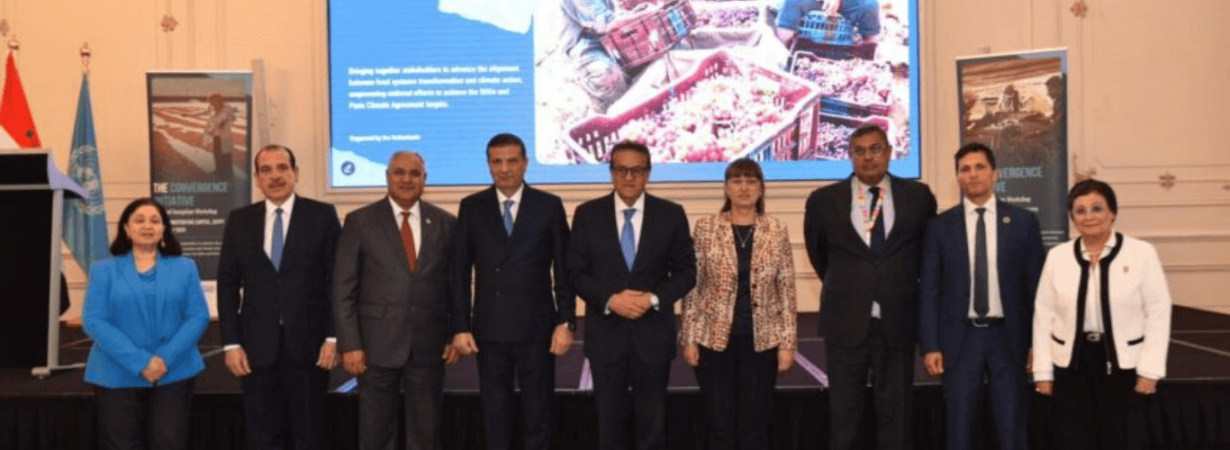
Egypt has made progress towards building a healthier and climate-resilient future by initiating the first national workshop for the “Convergence Initiative on Food Systems and Climate Action”.
The workshop with the support of the United Nations, the World Health Organization (WHO), and the World Bank is bringing together sectors in the food, health, and climate domains to work towards the long-term country development ambitions.
A National Uniting Moment
The event was opened by Deputy Prime Minister and Minister of Health Khaled Abdel Ghaffar, and Agriculture Minister Alaa Farouk, who label the event as a “unifying national moment”.
Abdel Ghaffar pointed out how Egypt is already making progress in public health, stating that child stunting has decreased from 21% to 13% in 2021, and aims to reach 10% stunting by 2030. He referenced existing successful programs, such as school feeding and food safety programs, but warned of ongoing public health challenges from malnutrition, climate-changing challenges, and declining economic purchasing power.
Convergence Action Plan (CAP) Launched
The workshop was also the inaugural launch of the Convergence Action Plan (CAP), a national agenda program that is the framework to align sectors to build resiliency in food systems, health improvements, and mitigate climate threats. The workshop was organized with the support of the UN Food Systems Coordination Hub, FAO, and the UN Resident Coordinator’s office in Egypt.
Planning for the future
In a recent video message, Planning Minister Rania Al-Mashat reiterated Egypt’s “long-term, integrated” policy approach through the National Climate Strategy 2050 and the NWFE (Nexus of Water, Food, watch Basic Environment, and Climate change and Energy) platform. These platforms showcase how Egypt seeks to develop interconnected approaches to achieve development, food security, and environmental goals.
Agriculture Minister Alaa Farouk underscored the need for urgent responses to food systems in light of the global food challenges facing us all, accepting the climate disaster that we will experience. He pointed to the efforts underway to produce more food locally, educated farmers on sustainable agricultural practices, and provide farmers access to technology and financing. You can imagine that, when Health Ministry spokesperson Hossam Abdel Ghaffar spoke about this initiative, it was specifically for the intention of creating an inclusive national strategy, founded on equity, resilience, and sustainability.