

Venus Fades Behind The Moon During A Rare Astronomical Conjunction
-
Dhivyanshu
- . March 25, 2023
- . Update: March 25, 2023 8:39 pm
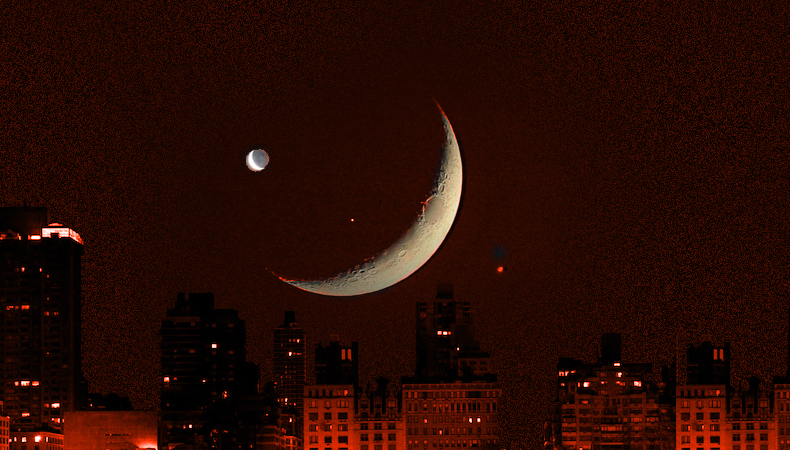
Skywatchers were treated to a rare celestial event as the planet Venus disappeared behind the Moon in a conjunction that occurred on the night of March 24, 2023.
The event, also known as an occultation, was visible in various parts of the world, providing stargazers with a rare opportunity to witness a breathtaking phenomenon.
The conjunction took place when Venus, the second planet from the Sun, passed behind the Moon in its orbit, resulting in the planet becoming hidden from view.
The Moon’s orbit is tilted slightly with respect to the plane of the solar system, meaning that Venus passes behind the Moon only a few times each century.
The conjunction was visible to observers in the eastern hemisphere, including much of Asia, Australia, and the Pacific Islands.
In some parts of the world, such as India and Pakistan, the event occurred in the early hours of the morning, while in other areas, such as Australia and New Zealand, it occurred in the evening.
Read | Snapchat promises new lineup of over 100 shows for Ramadan
Skywatchers were advised to use binoculars or telescopes to view the event, as it would not be visible to the naked eye.
However, those who did have the opportunity to witness the conjunction were treated to a spectacular sight, with Venus appearing to gradually disappear behind the Moon’s edge.
The event provided a unique opportunity for scientists to study the atmosphere of Venus. By observing the light that was reflected from the Moon during the occultation, researchers were able to learn more about the composition of the planet’s atmosphere and the conditions on its surface.
Occultations of Venus are relatively rare, occurring only once every few years. The last such event took place in 2017, and the next one is not expected to occur until 2030.
As such, skywatchers were urged to make the most of this unique opportunity to witness this rare celestial event.
In conclusion, the Venus-Moon conjunction was a rare and exciting celestial event that provided skywatchers with a unique opportunity to witness a breathtaking phenomenon.
Scientists were also able to take advantage of the event to learn more about Venus and its atmosphere. Those who missed the event can look forward to the next conjunction in 2030.